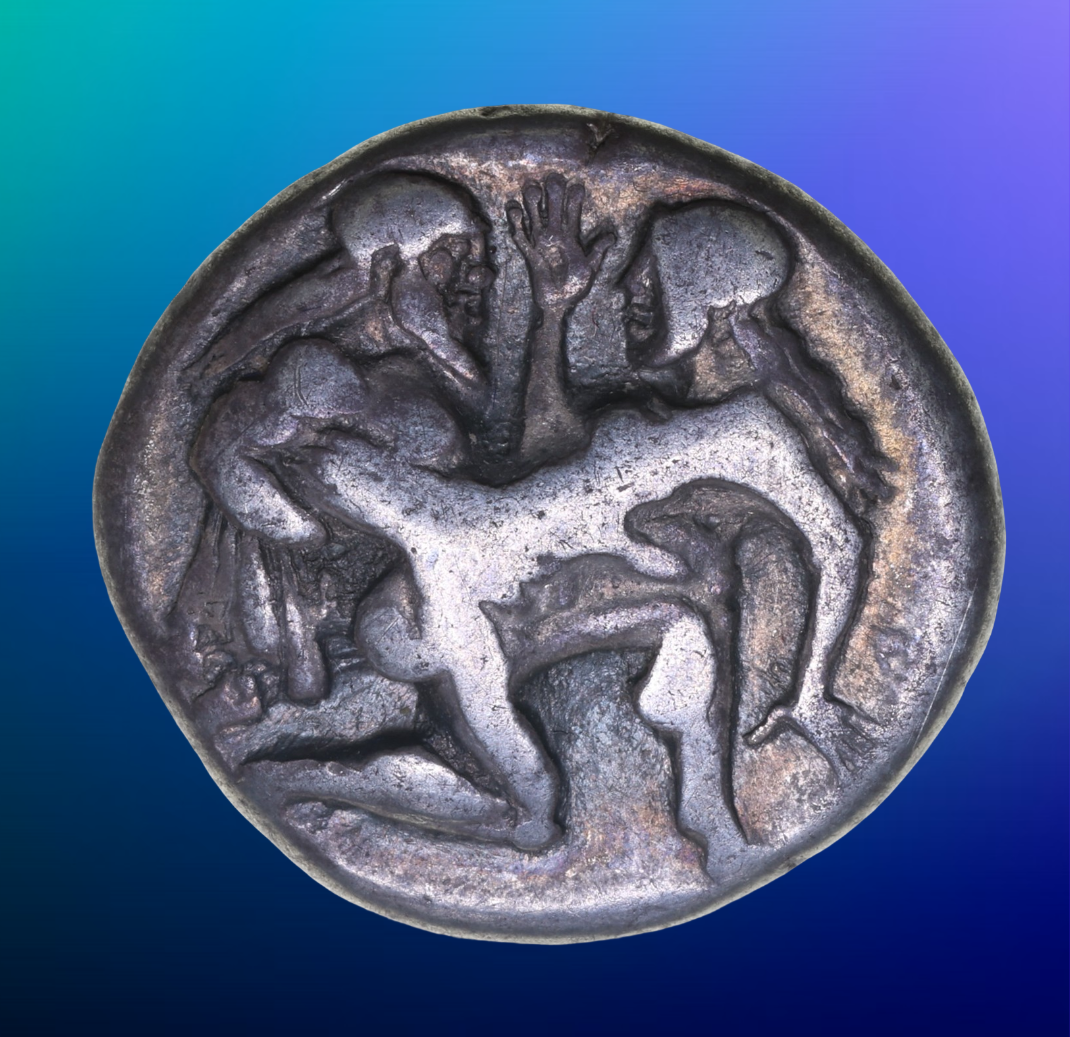
What is it we see here? A sexual motive, a creative one, an elemental one? The Greeks and Romans did not see as we do. The coin is a Thracian Thasos silver stater, 510-490 BC. It depicts a naked satyr with a nymph. 20mm, 8.50g. Someone forged it. Not with a factory machine; not with tech and software. But with their hands, sweat, blood, fire, hammer, and tongs. The gaze is an I meeting another native I. The image still has power; and unlike our culture, its artist still knows how to make image and form organically powerful.
Where the Greeks had swords, conquests, armor, helms with crests, and communication with their gods, we have clicks, feeds, phones, images, documentaries, and shows. Do we realize how the natural world speaks, acts, and lives through us? What happens when we switch off, or when the sun breaks through the leaves, and the different greens entrance us; or when the smell of rain prompts us to prayer; or in crisis, when we feel that life, God, no longer adequately accounts for him or herself? Do we then still have the means to think, without falling into slumber? What’s left for the vital decisions of life: to act this way or not that? In countless ways, we pay for a vast array of new technologies and sciences. We have to learn by trial and error. We have to strike the iron of matter with concepts:
“Thinking is an element of such a completely dynamic nature that it is completely absurd to think that it needs any other activity to bring it into flux, or that it cannot itself set things in motion.” (…) “In thinking we have given to us that element which welds our separate individuality into one whole with the cosmos. Insofar as we feel and perceive (and also experience), we are separate individuals; insofar as we think, we are the all-one being that penetrates all.” Rudolf Steiner, The Philosophy of Spiritual Activity (RS explicitly asked that “Freedom” in English translation be changed to “Spiritual Activity”, GA 4, 3. Thinking in the Service of Knowledge

Subscribe to continue reading
Become a paid subscriber to get access to the rest of this post and other exclusive content.