We were plugged in at an early age. All of us. Mums and dads too. They effectively sold a new world on the screen and through our ears. The 1980s, 90s, 2000s: our film heroes told us, with music and nice feelings, how to think and feel.
It started 100 years ago. The trauma of nuclear bombs, tortured and disfigured bodies, brothers, daughters, fathers, lost in the trenches of Europe or the jungles of Korea and Vietnam, is a visual one, a collective one. People need nicely dressed smiling faces, and glossy products, not so much to entertain but to anesthetize to trauma. The pop music and Hollywood said: Don’t worry – Sit back, eat crisps, drink beer, smoke. Apocalypse Now dressed up napalm as something beautifully orange, with Wagner in the background.
The lie is always: – Life starts somewhere on the screen. Or when you drift off into sleep on your sofa. Dream away. Rest in the arms of Ahriman. And collectively we did for the 1960s, 70s, 80s, 90s.
· The Matrix: Portrays a hero who wakes up to the Matrix, so you don’t have to.
· Lord of the Rings: Gives you epic fellowship and purpose, so you forget you don’t have them.
· “Friends” (1990): Functions like adult school; everyone together trading witty insights over coffee, telling you people are generally good, that life is kind and harmless.
· Star Wars: Offers control of the Force and noble good-against-evil battles for us to forget the Empire and our own freezing in carbonite.
Life is dangerous only when you forget context. The epic nature of spiritual reality is reduced. We forget.
Since childhood, we’ve been relentlessly programmed to shape our etheric bodies to fit the fallen ethers: electricity, electromagnetism, and now the rise of AI.
Subscribe to continue reading
Become a paid subscriber to get access to the rest of this post and other exclusive content.
Ahrimanic beings. Often, they bought our souls early in life, and we disappeared. Like the children or knights in fairy tales, we vanished into the forest. Our twentieth-century history is different from what we think it was. It was a psychological war, and it didn’t end. The war for your mind. Ahrimanic beings. They are beings now, around us, in society, living in people as hosts, determining much of what we experience in our lives and shaping our thinking and purposes. In UFO culture, they speak of ‘abduction,’ ‘hypnosis,’ the ‘stealing of one’s life path,’ ‘energy manipulation,’ ‘experimentation below the level of consciousness,’ and ‘orchestration of dreams.’
And while these are all symptomatic of the Ahrimanic effect, they are being dressed up as popular otherworldly fiction and fact. Hollywood has primed us for this surface-level view, like seeing images and figures in smoke. Those who would mind-control hold up the mirror behind the media’s smoke, and we are dazzled.
Managed from behind the scenes, we are supposed to be confused: while Ahriman hides.
To reclaim the occult subject of Ahriman from those who would mystify it into spiritual materialism and endless, limited hangouts of the intelligence services. Michael and Ahriman have to be spoken of in a way relevant to our personal paths in life. Ahriman works with lies. Covertly. Michael works with truth. Overtly.
In popular culture, the Greys, Ahrimanic beings, share a group mind. What one being thinks, they all know. Like a shared cloud of telepathy. They share penetrative insights into another person’s unconscious, instinctive impulses. They put anything given jurisdiction to them into action through your feelings. This is the image of the human being as a puppet. At first, people are unaware that their behavior in life is being steered from the Ahrimanic realm.
“Only if we clearly elaborate the Ahrimanic element and know the nature of the super-sensible influences which now arise as the counterpart, as it were, of Michael’s casting down of the Dragon. It is like a lifting up, out of Ahrimanic depths, of certain beings. And these beings find special points of attack in the human being if the latter yields to unbridled instinctive impulses and does not strive for clarity in relation to them.”
“Now, there exists today a method I might call it an anti-method, of concealing the instinctive element, by putting down a concept and pushing another over it, so that it is impossible to form a proper judgment concerning it.” Rudolf Steiner, The Mission of the Archangel Michael, GA 194. The Michael Deed and the Michael Influence as Counter-pole of the Ahrimanic Influence, 29 November 1919, Dornach
Jurisidiction?
In popular folklore, we know the adage, “the devil cannot enter your house without invitation.” Read the literature about “contact” with extraterrestrials, and you’ll find it is an affliction that often prompts a spiritual path to Christ as a means of healing: to uncover how we unwittingly, unconsciously welcomed Ahriman into our souls. This is one of the secrets those who understand the spiritual background of the twentieth century and into the twenty-first would have the public know little about in its esoteric depth:
“One can grasp that just the announcement of the mystery of beholding Christ, of this new relationship with humanity into which Christ will enter, would arouse ill-will and resistance from some human beings. These would be members of certain brotherhoods who wished to exploit the event of the twentieth century, this event of the appearance of the etheric Christ, who wished to use it for their own purposes and not allow it to become general human knowledge.” Rudolf Steiner, TheReappearance of Christ in the Etheric,GA 178,18 November, 1917, Dornach, 10. Individual Spirit Beings and the Undivided Foundation of the World I
What is the spiriutal trial of your life?
Now, another thing I want to bring in here is this: the question of time. Michael is no longer an Archangel, which means that the anthroposophical thinking path works with Michael as an Archai Spirit, a Spirit of Time. How do we feel and experience this?
C19th Archangel Saint Michael, Pedro Antonio Fresquis.
Look at the distinctions a person developing Michaelically will show against someone not doing this work, a more Ahrimanically influenced person. The latter have a very quick, instinctive ability to “see” into people. But they see only into people’s instincts. They can be very clever and perceptive, but only into people’s doubles: these beings are, by nature, meant to block higher spiritual views from the people involved. Now the other tendency is also there. The Luciferic-leaning soul. Not wanting the material comforts the Ahriman-driven person craves, but rather the ease of life that comes from following others, and absolving their own will.
Michael, as Time Spirit, shows you two things: Ahrimanically inspired people are too quick to dismiss others in their judgments. They do not wait long enough to know things spiritually, because they jump in and want to state facts now. Luciferically inclined souls are too slow. Their thinking dissipates and drifts, or simply vanishes, with little care for anything other than their own ease. Many people have a mixture. Too sentimental in self-regard and too critical in condemning others. Too indifferent to truth, or too quick to twist it.
Let me give a personal example of how this dynamic of time works.
In 2017, I had a car crash on Michaelmas Day, September 29. I drove a little frantically, around the city center on a Friday lunchtime, looking for a place to park. I drove over a stop sign and into an oncoming tram. In retrospect, I saw Michael imaginatively through the horizontal September sun. Physically, it blended me. Spiritually, it was symptomatic. As Rudolf Steiner points out, Michaelic karma can work through accidents because such times trigger a soul accounting of debts long since overdue.
Why? – Because there are two kinds of dream.
There are your true dreams of what you want and what you have to do according to your karma. This Ahriman will want to shroud. Lucifer will make you avoid them through your own “intelligence” poorly deployed. No time to think, and not knowing how to respond to life. I had accustomed myself to years of only seeming to work, busy out in the world, 95% action, 5% actual direction.
Gabriel’s Silver Light to Michael’s Gold Light
Our inheritance from Gabriel, the archangel who ruled from 1510 to 1879, is a popular one, expressed in common culture. Talking of Ahriman and Lucifer has entered modern vernacular. It is Narcissism, and Gaslighting is its technique, its method: Steiner well describes it as an “anti-method.” Speaking in opposites.
But it is also so much more: the double bind; gossip, slander, the witch hunt, the outcasting. We are now, in the twenty-first century, faced with something similar to what Alexander encountered at the end of the last Michael Age. The question of decadent cultures and individual karma. This prevailing culture, founded by Gabriel, is can be known under the watchword of Gabriel as “the swift power of the word,” where people build mirrored relationships of projection with each other in their karma; and this connects people to a emnerging materialistic culture. Words, in this sense of Gabriel’s rulership, are used as curses, bindings, praise, slogans, discourse, political manifestos, and poetry: but all these come to shape the collective mind quite differently in Gabriel’s Age than in Michael’s.
Fra Angelico, Michael San Marco 1423, 1424
Rising from Despondency
Rudolf Steiner speaks of this Michael age (1879 to 2300) and its lesson to be learned from the previous Michael age, 601 BC to 247 BC. Prior to that last Michael age, there was widespread despondency in the places of the spiritual mysteries. At the end of that age, Alexander the Great was able to sweep away, with exact Michaelic thinking, expressed in battle stratgey, the lax, slovenly empires of Persia. But at its beginning, that age of Michael saw renewal of the mysteries of Asia, with Buddha in the 6th century BC. He completely personalizes the spiritual path.
In Greece, Heraclitus of Ephesus (535 BC to 475 BC) shows the breaking in to consciousness of the fire of the Michaelic Spirit, so sun-like spiritually: the sovereign, independent, and yet social I.
“Out of every one-hundred men, ten shouldn’t even be there, eighty are just targets, nine are the real fighters, and we are lucky to have them, for they make the battle. Ah, but the one, one is a warrior and he will bring the others back.”― Heraclitus
So we have like two streams before Alexander The Great completely refigures the landscape. Buddha and Heraclitus at the relative beginning of the last time period riules by Michael. Then, centrally, Plato (428 to 348 BC) and Socrates (469 to 369 BC) in Greece. Look at how they transform the spiritual mysteries into ways that can change human discourse and the potential dynamics of human thinking. Look at those two distinctions.
The Michaelic impulse completely reforms what existed before it. It sweeps away the karma laid during the preceding Gabriel rulership period. It is thoroughly permeated with the spirit and radically reworks earthly life, human relations, and human karma. The same as now. Michael (1879 AD to 2300 AD) changes karma in a way the Gabriel ages (1510 AD to 1879 AD) cannot.
“The rulership of Gabriel is characterised by the fact that his impulses enter strongly into the physical bodily nature of man. Michael, on the other hand, works intensely into the spiritual being of man. You can tell this from the very fact that he is the administrator of the Cosmic Intelligence. But Michael’s impulses are strong and powerful. Taking their start from the spiritual, they work through and through the human being. They work into the spiritual, thence into the soul-nature, and thence again into the bodily nature of man.”
“Now in the karmic connections of life, these super-earthly forces are constantly at work. Beings of the higher Hierarchies are working with man and upon him. It is thus that the karma of a man takes shape. And so it is with the Michael-forces. Working as they do upon the whole human being, they work also very strongly into his karma. Gabriel-forces work only very little—I do not say not at all—but very little into the essential karma of a human being. Michael-forces on the other hand work very strongly into his karma.” Rudolf Steiner, Karmic Relationships III,GA 237,3 August 1924, Dornach, IX. Entry of the Michael Forces — Decisive Character of the Michael Impulses
Michael when fully committed to, changes what is rudderless, lost in time. This is a social art of karma, of bringing spiritual mysteries into life. As before, it is about overcoming the sense of demoralization in the existing conditions of the spiritual mysteries.
William Blake – The Annunciation to Zacharias by the Angel, 1799/ 1800, 26.7 x 38.1 cm, Metropolitan Museum of New York
The relevance of Blake’s Annunciation to Zacharias by the Angel.
“The old priest Zacharias was just about to burn incense in the dimly lit Jewish temple in Jerusalem when suddenly none other than the archangel Gabriel appeared to him. His gesture towards heaven underlines the divine origin of his message. He informs the high priest that he and his wife Elizabeth, who remained childless until old age, will conceive a son. They are to name him “John” (Hebrew for “God is gracious”, John the Baptist). Zechariah looks a little puzzled. His censer now hangs down unmotivated. Only the cloud of smoke tells us that it has just been moved wildly. Zechariah asks for a sign, whereupon the angel imprisons him with muteness until the son is born. This is both a sign and a punishment for Zacharias having doubted the message.” William Blake – The Annunciation to Zacharias by the Angelby Alexandra Tuschka.
Zechariah was made mute by Gabriel. In anthroposophy, just as in the wider world. The materialism of past centuries has flowed into human bodies due to the age of Gabriel. People are suggestible. But look at the temptations that come to and from the elites. It is Satanism. It mirrors an outworn moon impulse of Gabriel. We live in a culture, ruled by a fallen occult practice. Mysteries of the Moon, outdated, decadent occult mysteries.
“Something essentially different is appealed to: Proletarians of all countries, unite! What does this mean? It means: Foster your antipathy against the other classes, foster, as individuals, what resembles hate, and unite; that means, love one another, unite your feelings of hate, look for the love of one class, search among you for the love of the members of one class out of hate. Love one another out of hate, on the basis of hate.—There you have put down two concepts of opposing poles.”
Or let’s take a similar inverted case I knew. A few years back my superior in a company wanted to bring in a new co-worker as a trophy pin-up for the company. Creepy? Well, yes, but you can’t say that. Because, you are in the dragon’s lair. She remotely controls the employees below her, watching them play before her, and enjoys being referred to and deferred to. The new handsome American figurehead for the global enterprise gets raised up, and then, when the group of coworkers are given nothing to do, no responsibility, and assigned menial tasks, she sits back and says it’s a shame they have poor character. Poor lost souls, she reasons. Just like the pet dog she keeps. One is raised and others demoted. But the key to recognise here, is truth cannot be spoken. It has to remain mute.
These are the intrigues which Ahrimanic beings perform:
“And what do they want? They burrow, as it were, in the deepest stratum of consciousness in which the human being is still asleep today in his waking state. Man does not notice how these beings enter his soul and also his body. Here they suck in, with their power of attraction, everything that has remained Luciferic, that has not become Christ-permeated. This they can reach: this they can take possession of.” Rudolf Steiner, The Mission of the Archangel Michael,GA 194,29 November 1919, Dornach, 5. The Michael Deed and the Michael Influence as Counter-pole of the Ahrimanic Influence.
Look a little deeper into such types and excuse the image, but you find spiritually thick dirty blood, with no etheric light, like the greens and dark browns of putrid water: They bristle at criticism because you catch them in the act!
“Few love to hear the sins they love to act. ’Twould braid yourself too near for me to tell it.”
And then the gray eminence behind the scenes – the owner – a character who says, “I have nothing to do with the “running” of the company. But yet, I own it. But I shall say nothing. I delegate that.” But in the gentlemen’s clubs – I shall share my amusing stories about how this is the way to run a company. It’s wise, cunning, efficient – simply good “management” of human behavior.
… And there is little to differentiate these two leading characters. There is no uniqueness of soul expression. The human I is absent.
Manichaean Mysteries of Evil
What can we learn from this as we go deeper into a commitment to anthroposophy and a more conscious relationship to Michael and Ahriman?
“All manner of karmic experiences come to the individual, each in his own way. The one will have this or that to undergo through the fact that he must tear himself loose from old connections and unite with those who are seeking to cultivate the message of Michael. There are some who feel this union with the mission of Michael as a kind of salvation. There are others who feel it in a different way, finding themselves in this position: ‘I am drawn to Michael on the one hand and to Ahrimanism on the other. I cannot choose. Through my life I stand in the midst of these things.’” Rudolf Steiner, Karmic Relationships III,GA 237,1 August 1924, Dornach VIII. Ahriman’s Fight Against the Michael Principle — The Message of Michael
To sum up: In my last two jobs, I saw this explicitly. Men and women, professionally competent and secure. Both companies were half business, half public-facing institutions. Entrepreneurs, psychologists, doctors, men and women of high learning and science: training professionals. And yet each one, with their soul connection to themselves, was fearful of saying the wrong thing, on edge, anxious, hypervigilant. Hierarchy was highly esteemed, even when employees spent the whole day deriding it. Living behind these soul contradictions, each one acted as if hyper-alert, lacking peace. And yet our clients were individuals seeking healing.
A “bowl o’meal Fraser”. Allegance by Affinity.
What ails thee?
On November 29th, 1919 (GA 194), Rudolf Steiner reflected on how we have lost our connection to grand, conscious, and epic cosmic missions. Today, humanity feels “forced to accept the omnipotence of natural necessity.” We are told that we are nothing but biological machines, subject only to material laws and economic pressures.
We must find the courage to perceive what is happening karmically in these settings dominated by Ahrimanic beings. This path will create daunting feelings because you are over the target. Such experiences give us invaluable lessons in witnessing darkness and evil and in carrying a light for humanity’s future. Lucifer wants you in a box sealed off from the spiritual, content with your simple projections on the walls around you. A coffin. Ahriman wants you buried in the beings of your instincts. A grave. Michael demands our conscious initiative.
There is a far reaching Bible quote to meditate on with reagrds all we are saying here with regards karma, working socially with these mysteries, and establishing these new relations from heaven to earth. It is the passage where Peter is counselled by Christ as to how a true esoteric church is built and managed: First-century Jewish rabbis used “binding” (prohibiting or declaring unlawful: jurisdiction) and “loosing” (permitting or declaring lawful: recinding) as technical terms for making legal and moral decisions.
Mathew 16: 19 “I will give you the keys of the kingdom of heaven; whatever you bind on earth will be bound in heaven, and whatever you loose on earth will be loosed in heaven.”
Christ’s counsel is to not overlook any thing you experience with reagrds another person in life; but to seek to bring it to full consciousness. To change etherically you cannot stay around some places and groups. At least not the same way as before. You have to change relations to the places you are in. Because these are invariably karmic settings that ask you to trade your spiritual sovereignty for lower impulses. With MIchael we pay that invoice.
“To cow before something” means to be intimidated, frightened, or made submissive by someone or something.
When you “cow” before a person, a threat, or a challenge, you lose your courage and give in to fear. At this our Michaelmas, wake up your “I.” Refuse to cow, and let the sun become veiled. This is the true gold credited to your account by Michael.
A “Boll o’ Meal Fraser” (often spelled “Bowl o’ Meal”) is a historical Scottish term for an “allegiance by affinity”—a person or family who joined Clan Fraser of Lovat not by blood, but by adopting the surname in exchange for protection, sustenance, or land.
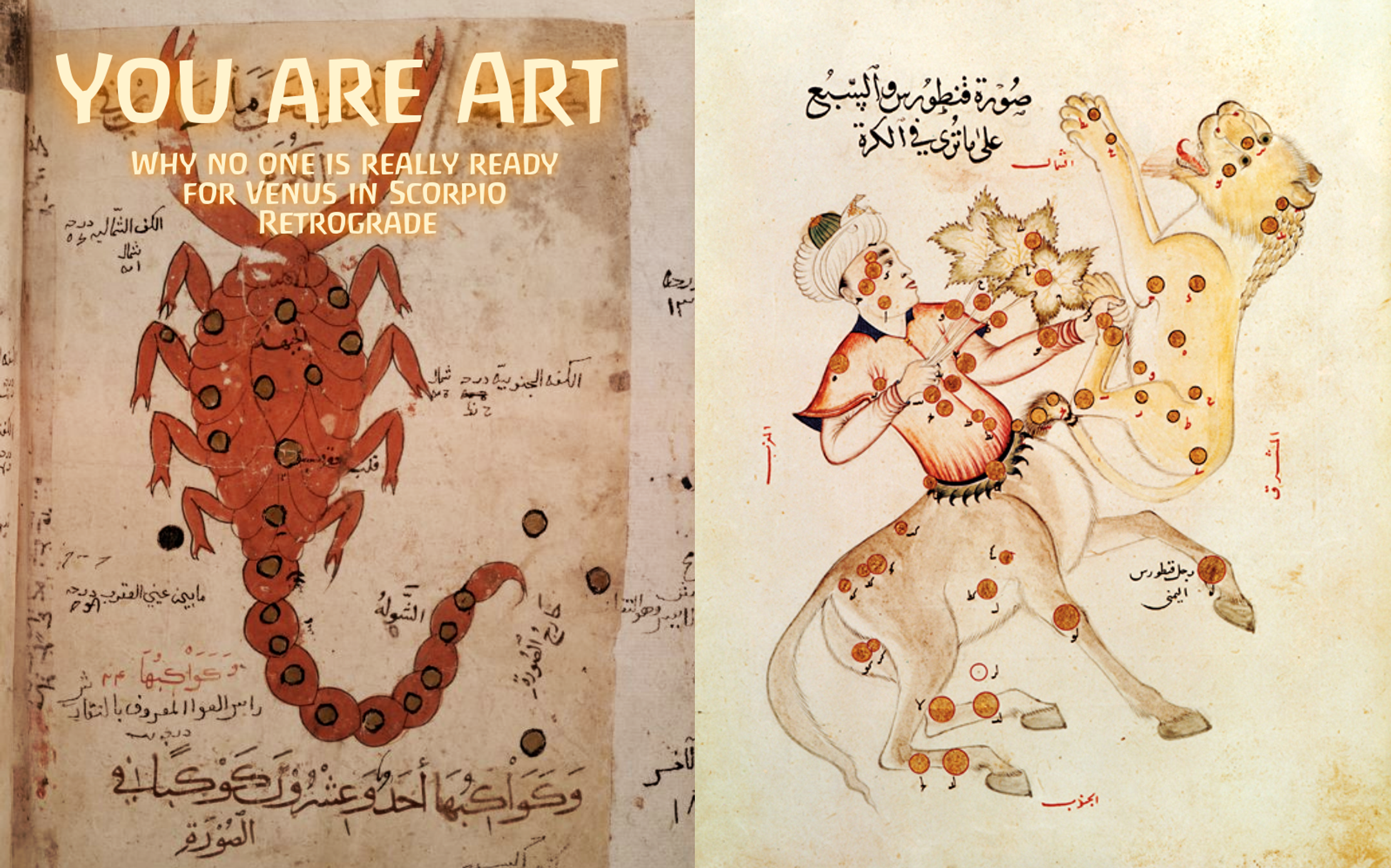
It’s going to be a true test – Seeing things you might find shocking. But we need it because we are at a crossroads. Increasingly, people will slip off the radar into a kind of hypnosis, while others wake up. This Venus Scorpio Retrograde is like drawing battle lines. AI-Teach or You. You or Art. Whether you are positive or negative in life. Not in the wishy-washy way. I mean in every aspect of your being. Is your living of karma, of destiny, of life, vibrant? Not cowering, disowning parts of yourself, forgetting bits and pieces of you. But are you honest before God, standing for all you are, with others, as equals? And finally, what do you create and why? Or, and this is the lesson of the Scorpion’s tail: are your waters stagnant, and are you only looking out for yourself, to wear a carefully crafted mask?
Venus is not just about “relationships” and romance, as so commonly bandied about. It is also Nature and Art. Our relationship with the earthly, with the senses, yes, but nature through those senses as a gift to unfold what we can only unfold here, on earth, in incarnation. Whether retrograde or moving forward after that, Scorpio has a sting in its thinking tail. Venus retrogrades pass by or transform you completely, to the degree that you walk a creative path.
In anthroposophical terms, it is learning to be conscious of Lucifer and Ahriman as blocks to spiritual awakening and walking a middle path. This is how we come to Michael now at this time of year. This is how we see the dragon. We feel and live in the warm afterglow of summer, while looking up to the stars and sincerely looking back at the karmic path down here in earthly life.
This year it has this distinctly Venus Scorpio flavor. That is, it will feel particularly intense. One symptom of which is sensing the golden afterglow of summer more intimately.
It speaks in a way only Scorpio knows how to, of initiation and transformation and speech and art: as homage to its co-rulers Pluto of the underworld and Mars*.
This is part of Rudolf Steiner’s gift as the initiate (*), the one who knew how to prepare us for these times, one hundred years ago. We come to know Michael at Michaelmas, as much as in our lives and karma, when we can hold at bay the two opposing spiritual forces of a truly future-oriented life. On one side, Lucifer, and on the other, Ahriman. Properly understood, rather than Vanity and materialism, they should be spiritualized love and selflessness.
If we respond positively and spiritually to the Venus Retrograde, we may walk this middle path, and the unconscious influence of the dragon may be shed as we become conscious of it. But of course, woe betide what is seen yet continues in perfidy. Because Venus is a truly social impulse. And Scorpio is a thoroughly penetrative spirit. So these are times when we can see the true roots and hidden places of what people think they carry hidden in the dark. Collectively, because everyone goes through the Venus transit retrograde and realizes their own failures of inner truth in the eyes of the spirit, you see, it has a collective effect. Now, if you’re wise, you see where the paths will lead for you and for others.
Subscribe to continue reading
Become a paid subscriber to get access to the rest of this post and other exclusive content.
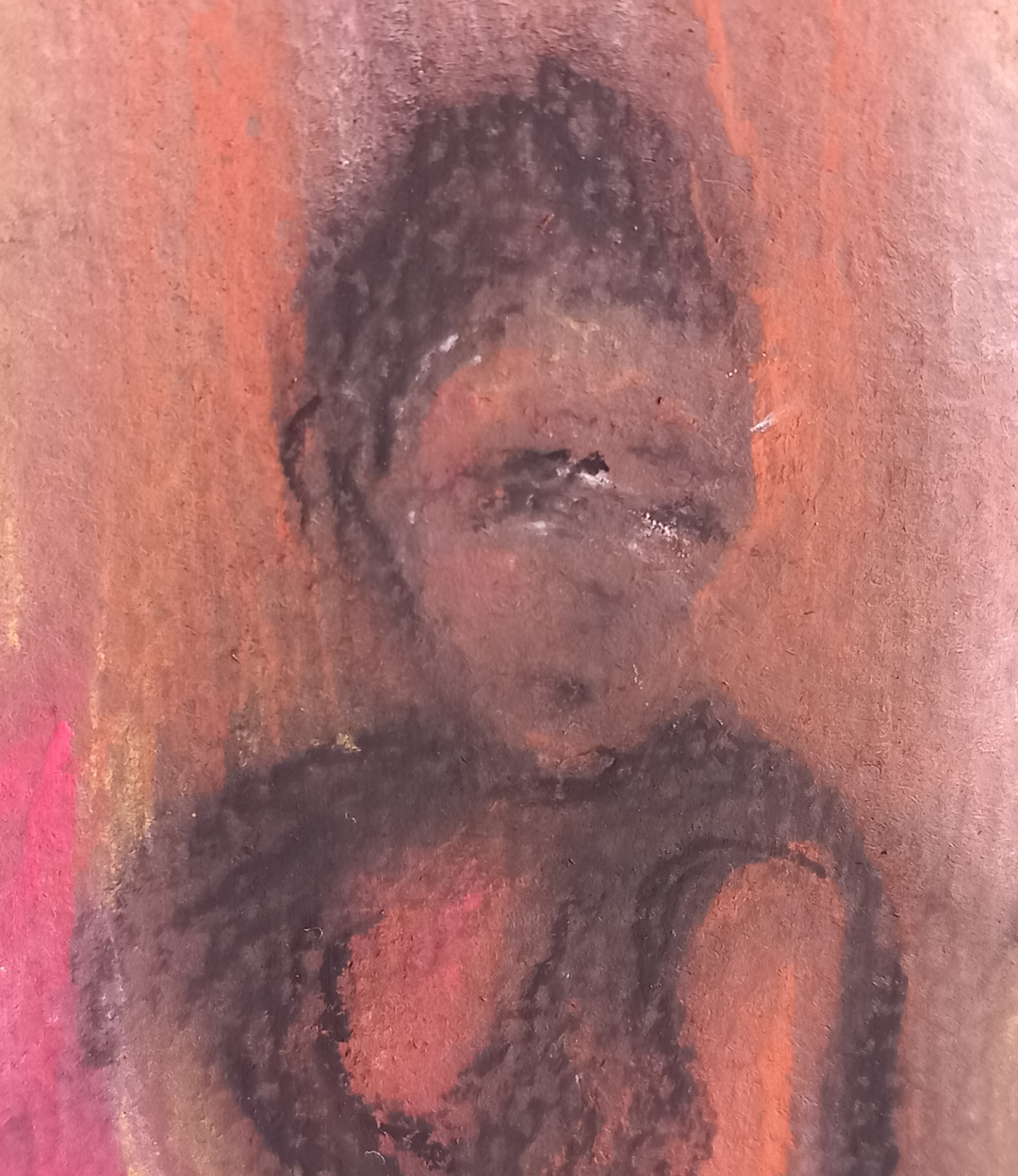
I painted a provocative spectacle back in 2012: A big woman with dark red plastic leg ins. Silvery-white hair with a pink-dyed stripe.
April 2012. Gold was at $1,700. In the aftermath of the 2008 global financial crisis, quantitative easing (QE) from central banks, and even the “2012 Mayan apocalypse” predictions had their effect; “hard money” enthusiasts were highly energized.
Was my – Deutsche Frau Ausserhalb der UBS Basel – “German Lady Outside the UBS Basel similarly “energized”?
Outside, on the street, she was standing with two crutches.
A German woman. Here for a visit, a day trip, to save on VAT, who knows.
I thought it was beautiful. The whole scene. Tragi-comic.
If you live in Basel, you know the difference instantly. The Swiss are affluent, self-contained, often healthier. The Germans who cross the border are different—less well off, often worn down. Victims of our society. Go to Germany, and I’m always reminded of the UK: boy racer techno cars, gangs, the smell of weed. Tattoo and barbershops.
You can romanticize and say the mountains form the Swiss, or you can cycnicize and say the money does.
Subscribe to continue reading
Become a paid subscriber to get access to the rest of this post and other exclusive content.
Any war, market crash, or period of stress eventually ends. Jobs, inflation, interest rates, unemployment, civil unrest, and the whole economic system; when everything is stacked against you, at some point you realize that to deal with anxiety, you have to start looking scary things in the eye. So that’s the first thing. In these apocalyptic times, there is no Julie Andrews’ Switzerland, no USA, no safe haven, no underground bunker that is going to practically help you. Instead, you have to learn to watch, one by one, as the Von Trapp family singers get fewer. You have to chart a course by turning off the collective music. You can only do that by learning new ways of thinking and engaging enough to start learning not just economics, but a new social life by dynamizing your life perspective.
We are all economically active. Active throughout our lives. In a way we have to take back thinking authority from universities, media, think tanks and global institutions: firstly in the soul: I like to think these newsletters could become like intel for the little guys, a collective group of Davids against Goliath, where what we share here can grow into a force that changes perspectives.
1 Samuel (33-37) David’s training as a shepherd prepared him.
And Saul said to David, “You are not able to go against this Philistine to fight with him; for you are a youth, and he is a man of war from his youth.” But David said to Saul, “Your servant used to keep his father’s sheep, and when a lion or a bear came and took a lamb out of the flock, I went out after it and struck it, and delivered the lamb from its mouth; and when it arose against me, I caught it by its beard, and struck and killed it.”
What is “generosity,” and in relation to money in its deepest principle?
It is giving away as the sharing of your soul and spirit. The new life we enable by providing something for another that otherwise wouldn’t have been there. Broadly, we have called this “endowment.” In German, “Stiftung.” I will define it again here for us: “enabling new life for others through giving away money.”
The Fed has been hiding “money printing” behind Quantitative Easing for years now, back to 2008. Back then, we were aghast at QE 1, 2, 3. They are controlling the narrative more adroitly now: regardless of whether the Fed calls it “organic balance-sheet growth” or “RMPs”, or intervention to maintain stability, any systematic buying that expands the central bank’s balance sheet operates as a pseudo form of QE by pumping fresh liquidity back into the financial system.
Think of the roaring 20s parallel. It’s not an explicit re-run of 100 years ago. It’s more like a global expansion of those conditions, Germany to Europe, Israel and the USA as Britain and America; but now Asia, Africa, South America thrown into the mix that can only utterly skew parallels to the 20s Great Depression and the world wars.
So, we have to keep going and keep swimming with the facts as they arise.
During a recent cabinet meeting at Camp David, a press photograph caught a glimpse over the shoulder of U.S. Treasury Secretary Scott Bessent. Underlined on his notepad was a literal “To Do” list that read: “Buy Japanese Yen (JPY) $5-10 bil.” This then sends the markets into a frenzy. Now, just like in 2008, you can find dozens of macroeconomic specialists on YouTube explaining how and why the stock market is going to crash and how gold and silver will multiply their values by 10 or more.
⚠️ 1. The Trap of Never Ending Accumulation
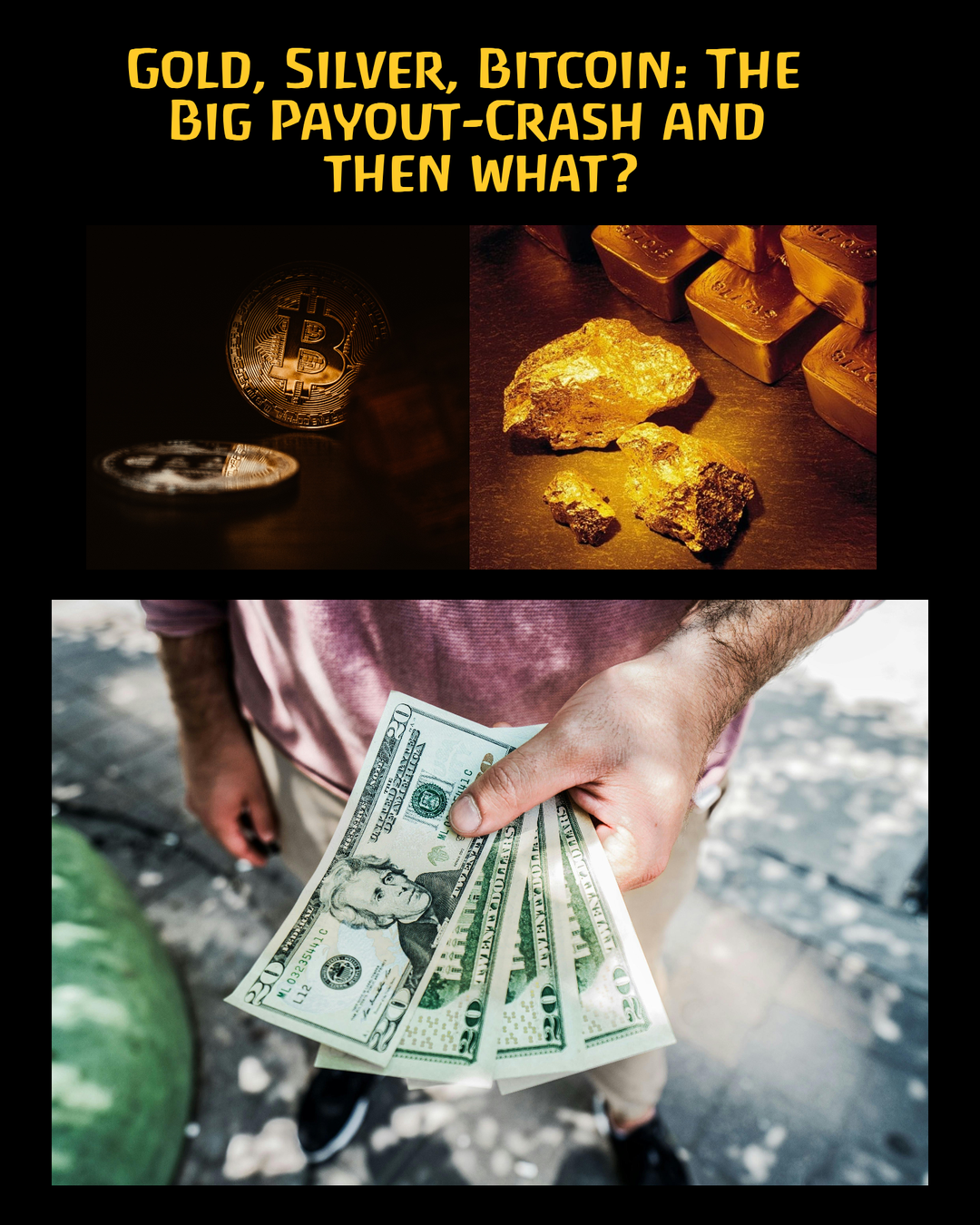
In 2026: Gold has soared to historic highs around $4,587 per ounce (a massive 37%+ jump over the past year). Similarly, Silver has crossed the threshold to $69.61 per ounce, up over 82% from its previous cycle.
Vague confusion sets in like a fog.
Then the questions shift to real physical Gold and Silver, or to paper-based ETFs and Mining Stocks. Or Bitcoin, AI, and Robotics. But if this was you then over the 16-year period leading up to May 2026, your gold rose by approximately 278% while silver rose by approximately 318% in nominal U.S. dollar terms, and if you were smart enough to have cashed in this year – what for?
A former acquaintance of mine, over the time I knew him, has been collecting silver and gold bars; leveraging them with plans for his future reich. He wasn’t 10% into gold as is sensible in an investment portfolio. He was 100% in. At the same time, he ran seminars where he would simply play YouTube videos and called it analysis.
Will he catch the market right and cash his winnings in?
Will he miss-time the next crash and correction and regret it for 20 years, anxiously watching the price. And what then: property, stocks, move to Argentina?
But none of this is the point. My argument here is for something very different. That the real driver of value in all this psychology is that you often treat your money, your life, and yourself as if you were dead. This is what makes a Goliath in the first place.
📈 2. Realities of the Current Market (And the Hoarding Illusion)
However many specialists advise the contrary, most people buy with the crowd at the top of the market and sell at the bottom, even when they know emotion should not overwhelm thinking. Swapping paper currency for gold bars or Bitcoin feels like escaping the matrix, but history shows that governments can change the rules. Gold confiscation. Or resetting it with a new basket of currencies as suggested before 2008 – at the last crisis – with SDRs (Special Drawing Rights).
“The world is going through the worst economic crisis in peacetime since the Great Depression. In around 150 countries, income per capita this year will be lower than in 2019. Many countries are less able to pay for vaccines or invest in their recovery – and are more indebted.
This is where a new SDR allocation comes in. It supplements countries’ reserves, using the collective strength of the Fund’s membership to make all 191 member countries a little stronger. It would provide liquidity support to many developing and low-income countries that are struggling, allowing them to pay for healthcare and support vulnerable people. All countries will benefit from a quick eradication of the virus. It is important to make sure they all have the financial resources to do that. IMF 7 Things You Need to Know About SDR Allocations. “
If we read carefully, this shows us something we all know intuitively well. Financial crises further agendas. Climate, Agenda 2020, 40. Carbon taxes. Vaccines and the Third World as pillars to keep such plans on track.
So, again, let’s learn to be cute: From modern emergency banking laws, to a total currency reset, if political turmoil hits or the digital grid fractures, your hidden gold or private crypto keys won’t easily buy you safety, health, or a plane ticket.
But there’s always the same question that triggers. What comes after the market crash and potential currency reset?
I once had a client who was Swiss pension fund executive preparing for his annual speech. He outlined something everyone in the pension industry kind of knew: pension funds were unsustainable. It’s like they’d all agreed to rearrange the chairs on the Titanic.
We are in fact surrounded by installed spokespeople demanding you save every penny for a far-off future. Advanced AI systems like Jump, FP Alpha, and Holistiplan are now standard tools firms use to scan tax records, and predict behavioral patterns (the feed tracks your every thinking whim).
These two quandaries about motivation and future orientation set up nicely; our first step through the veil: the need to undertake soul accounting.
Where have you become miserly not of money but of your very own soul? List the instances. Do an inventory. What joys do you shut down? What careful strategic position do you maintain to avoid meeting and learning new things? Look at yourself from outside with an uncompromising eye. What have you neglected to actually do, and more importantly, who have you neglected to be? When did you stop reaching out and being part of your own life as much as others’ lives, and where you have condemned others, what do you see of yourself mirrored in them? Where do you need to wake up to this emotional waste?
Now in your inventory of your soul, you’ll learn to see the two David and Goliath yous. The Good you – not before or after the crash or survival or battle you are protecting yourself from – but you free. And every time you buy the clothes, book the holidays, make the new connections you put off or disregard, you will learn to see the you and the others caring for their Goliaths.
These strikes at consciousness we have to do to ourselves: and they are about getting you out of your passive soul cage. We could even say there is a resentful version of you these global agendas would have you be.
⏱️ 3. Having a Spending rather than A Savings Plan
My acquaintance at £50,000 per ounce gold would say, “Hey, but I’m already rich, and will quite soon be getting even richer!” And sometimes I imagine a fantasy conversation with him at 92, where I ask him: “How much do you still need?” … Saving for the next incarnation? Where your feeling of safety is turned inside out, and you have to experience its opposite.
… But I guess at 92, he would still blankly say … time left for what?
As always, these letters are like a call, they start as a small seed, but we are learning to see the grain at the end of the deeds we do and don’t do.
Hebrews 7:7 And beyond all contradiction, the lesser is blessed by the greater.
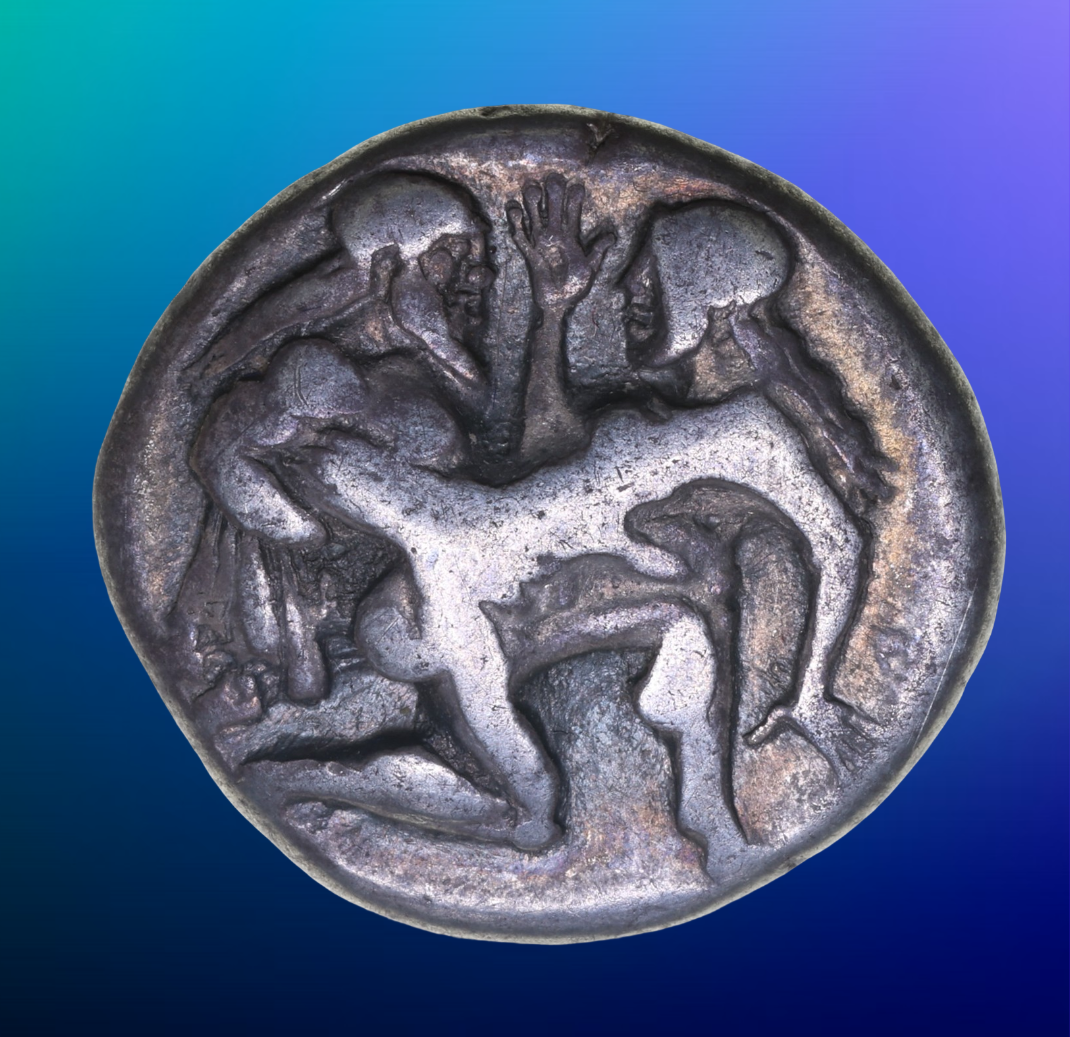
What is it we see here? A sexual motive, a creative one, an elemental one? The Greeks and Romans did not see as we do. The coin is a Thracian Thasos silver stater, 510-490 BC. It depicts a naked satyr with a nymph. 20mm, 8.50g. Someone forged it. Not with a factory machine; not with tech and software. But with their hands, sweat, blood, fire, hammer, and tongs. The gaze is an I meeting another native I. The image still has power; and unlike our culture, its artist still knows how to make image and form organically powerful.
Where the Greeks had swords, conquests, armor, helms with crests, and communication with their gods, we have clicks, feeds, phones, images, documentaries, and shows. Do we realize how the natural world speaks, acts, and lives through us? What happens when we switch off, or when the sun breaks through the leaves, and the different greens entrance us; or when the smell of rain prompts us to prayer; or in crisis, when we feel that life, God, no longer adequately accounts for him or herself? Do we then still have the means to think, without falling into slumber? What’s left for the vital decisions of life: to act this way or not that? In countless ways, we pay for a vast array of new technologies and sciences. We have to learn by trial and error. We have to strike the iron of matter with concepts:
“Thinking is an element of such a completely dynamic nature that it is completely absurd to think that it needs any other activity to bring it into flux, or that it cannot itself set things in motion.” (…) “In thinking we have given to us that element which welds our separate individuality into one whole with the cosmos. Insofar as we feel and perceive (and also experience), we are separate individuals; insofar as we think, we are the all-one being that penetrates all.” Rudolf Steiner, The Philosophy of Spiritual Activity (RS explicitly asked that “Freedom” in English translation be changed to “Spiritual Activity”, GA 4, 3. Thinking in the Service of Knowledge
Subscribe to continue reading
Become a paid subscriber to get access to the rest of this post and other exclusive content.
There are people who still maintain a human level in their interactions and behave on social media as they would in life. No matter what they post, whichever photo, or whatever they appear to do, you feel you know them, because you have sufficient strength of I not to be overwhelmed by the digital images and the being of the technology we know is simply like a window. Now there is also a whole spectrum of experience that comes through social media that shows the opposite inclination, where the context of social media is not held upright enough with the I, and the ego instead twists it. Ask yourself this, which happens so often on social media that we overlook it: How would it be if I were to meet a person in real life, in a park for example, and that person would immediately call you a name and run away and hide behind a tree?
Trolls don’t like bridges. In social media, the action of a “troll”; if we transpose it back into reality, gives us the impression that this is the behavior of a human child. A naughty boy. Or a wayward girl. But the term troll cleverly reminds us of elemental beings. Social media simply creates a new marketplace for valuing, devaluing, and pricing each other, much like bourgeois life used to assess the ladies and gentlemen promenading – but now with an added spiritual element. Or, consider this: when social media becomes spamming and unsolicited advances, we might picture a member of a gang of boys in a park, for example, seeking to intimidate people. Boys hanging around, seeking a cheap thrill from being rude or threatening passers-by. Or if it is an individual targeting us, are they actually wanting to speak to other human beings, but shy to engage in conversation, like emotionally eight years old, hiding behind their mother or father’s legs?
We know these impressions from real life. These are just imaginative pictures of what many adults do on social media. Reality is slowly splitting, fragmenting; borders and thresholds are becoming porous; and this has been going on for more than a while.
When this place we write and display and perform upon is our marketplace to trade, to present ideas, and to awaken interest, does it unduly surprise us to call these economic considerations?
In relation to money and economics, John Maynard Keynes’ brings our attention to the illusory aspect of any assertion that economics be a strict or disciplined science. Without understanding that economics is inextricably linked to social psychology and its esoteric drivers, we overlook what lies somewhat unconsciously in the soul, like a huge sea (which is why the Greek Poseidon, we can now intuit as a former reflection on Ahriman, shapeshifting and powerful). Keynes called the aspects of ourselves we need to learn to recognize in relation to economics our gut feelings or “animal spirits”, our motivations or drives that manifest socially. With words and gestures, written or symbolic, we signal where we are at in terms of a certain kind of energy; a relation to a wider economic sea of unconsciousness.
“This means, unfortunately, not only that slumps and depressions are exaggerated in degree, but that economic prosperity is excessively dependent on a political and social atmosphere which is congenial to the average business man. (…) In estimating the prospects of investment, we must have regard, therefore, to the nerves and hysteria and even the digestions and reactions to the weather of those upon whose spontaneous activity it largely depends. (…) We are merely reminding ourselves that human decisions affecting the future, whether personal or political or economic, cannot depend on strict mathematical expectation, since the basis for making such calculations does not exist; and that it is our innate urge to activity which makes the wheels go round, our rational selves choosing between the alternatives as best we are able, calculating where we can, but often falling back for our motive on whim or sentiment or chance.” John Maynard Keynes (2012) [1936], The General Theory of Employment, Interest and Money, Snowball Publishing, p.161-3.
Rudolf Steiner spoke positively about economist John Maynard Keynes in 1920, specifically praising Keynes’s book The Economic Consequences of the Peace for its realistic critique of the Treaty of Versailles; which engineered the consequence that a second world war would arise out of the first. Not least, one senses between them, one in Germany one in Great Britain, a shared appreciation of the soul and its implications for the root of historical change in economics. The “sentiment,” Keynes speaks of, is also the shared sentiment that most people in public life of the time were not thinking of much at all: besides business as usual, and they were servants of materialism, or as Steiner famously stated, people of responsibility unable to exercise any responsible steering of humanity because they “sleepwalked” through world historical events.
Perhaps the only two of their time to publicly and professionally attempt to draw the necessary media attention to a relation to the consequences of decadent relations to money?
Animal Spirits and Elemental Instincts
Most of the time, we use the name Ahriman, and we do so by habit. Ahriman and Angra Mainyu are the exact same figure. Angra Mainyu is the original name in the ancient Avestan language, while Ahriman is the later form of that same name in Middle Persian (Pahlavi). But taste the letters and read their meaning, and you will discover something. In the earliest Zoroastrian scriptures, like the Avesta, Angra Mainyu means destructive or evil mind. The name evolves into Ahriman through its use and pronunciation over time.
Subscribe to continue reading
Subscribe to get access to the rest of this post and other subscriber-only content.
Up until a certain moment in life, patterns are hidden. Ways are blocked. Situations feel stagnant. There’s a park near me here that is constantly in construction. There’s a big pond, and it’s full of turtles. You aren’t allowed to swim in this pond. It’s probably dangerous, not only due to the quality of the water, but also because of all the trash and rusty old dangerous things dumped in it. Imagine going in; you might cut your foot on an old beer bottle discarded on some wild night. This is a picture for Scorpio in Venus, and the retrograde cycle drags up buried ghosts to be put to rest. But there’s another image here. The turtles. They swim about kind of oblivious to the darkness, the dirtiness; quite happily semi-floating around. The danger is that in life we simply go round in circles, relatively comfortable in old ponds.
However used to them we are, surprises of destiny and karma come to shake us out of our shells. Through decades, cycles of time, years and life phases, we often have no idea what was going on karmically until we get new keys of consciousness, and for those to be given, we have to wait on two things, one passive, one active; divine timing is an outer restraint, but inner reflection is always present to the degree we engage with it. For the spiritual student, it’s just not like normal life: we are crisis-prone.
It is a big step to realize that every personal life crisis is not at all cause for dismay, but a chance to open up spiritually.
Worn-out Consciousness
Painting at the end of the nineteenth century was like that. As if it didn’t know what it was anymore: because the human being didn’t know who he or she was anymore. The human being was on the road to becoming fake. And masks were all that would be left. The last cry of humanity before its descent into deeper darkness was reflected in a late 1800s painting in which spiritual scenes were like caricatures. To be a painter was to be a decorator of the Victorian lounge of the mind, a thoroughly bourgeois connection to the spiritual world. Like now but with seances and smoke-filled salons. Back then, paintings like Gustave Moreau’s of King David and the angel are symptomatic of pretend spirituality. King David fawns to the angel with a rose.
Subscribe to continue reading
Become a paid subscriber to get access to the rest of this post and other exclusive content.
Finding the way from the spirits of Personality to the true Michaelic legacy of America for the Spirit.
Pictures and Images: Do we realize how much they influence us? Through the power of media, Hollywood, Amerikana? I remember a while back in the early 20 teens, a rather entertaining German alternative researcher, especially prominent in 2020. He had a specific way of speaking to the audience. He was ironically provocative. To audiences eager to wake up to geopolitical events, yet somehow passive, confused, and lacking insight into cultural hypnosis, he said something along these lines –“If you don’t start thinking, there are whole industries, massive amounts of money and resources poured into making sure you will be given the content that you think.” He had attended a Waldorf school and was vehemently scapegoated by the German mainstream media for what he did and publicly said in response to the 2020 pandemic.
Back then, as we shall see, he, like many others, lost his German citizenship and was forced to move to Switzerland amid a political witch hunt. Switzerland, at least for the time being, offered a (probably minimal) degree of independence from the more draconian geopolitical dictates, thanks to its traditions of neutrality. In contrast to the general mire of submission across the media landscape, we could admire his courage. Anthroposophists who spoke out were labelled “Querdenker,” which I’ll translate as “crooked thinkers,” rebels, and “outlandish.” Any idea that anthroposophy should, per Steiner, not be political was thrown under the bus. Back then, any doctor who refused to tow the official state line was struck off. Teachers were sacked, including many in Rudolf Steiner schools. Some had to leave the country.
But what to do?
Subscribe to continue reading
Become a paid subscriber to get access to the rest of this post and other exclusive content.
There is a spiritual battle underway in modern times, beneath the surface of people’s lives. It is going on in the soul, and it is a spiritual battle. Now part of this battle is winning back from Ahriman the soul “ownership”, the use of the two-petalled lotus flower between the eyes.
To regain this, we can reclaim the experience lost in Ahriman’s realm. But most will say, “Hey, I didn’t even know I was lost in any “realm”!” But really, it should not be such a great secret at all. It’s been packaged for us as the Matrix, the Internet, now AI, and in all the sci-fi populism of the last 100 years. In the development of radio, communications, and consumerism. We don’t have to be dismayed by this. A vast amount of creative time and energy has indeed been put into building an electromagnetic network of psychological influence.
So, we can say that the incessant images of modern life, which fill the sentient body for entertainment, consumption, influence, suggestion, and control, all surround a central protagonist, “You,” within a vast, numerically programmed system of intricate layers and veils. Getting out and finding spiritual freedom within such a context seems so overwhelming. For it is emotionally designed this way. And yet, hopelessness and the brute survival of the fittest are the very symptoms intended by the system. But so too is the rise in the face of adversity.
The spirit of the phoenix. This should be a routine, obligatory spiritual step in modern life. With anthroposophy, we can, precisely in these times of challenge to a spiritual orientation to life, rise from so-called “occult” entertainment and hypnosis to a new spiritual experience.
Meditation and transforming of character
In meditation, we hold the two eyes with the gaze fixed at a midpoint between them. This is the position of the two-petalled lotus flower, the chakra at the bridge of the nose, extended before us in space naturally about 10 cm out.
Subscribe to continue reading
Become a paid subscriber to get access to the rest of this post and other exclusive content.