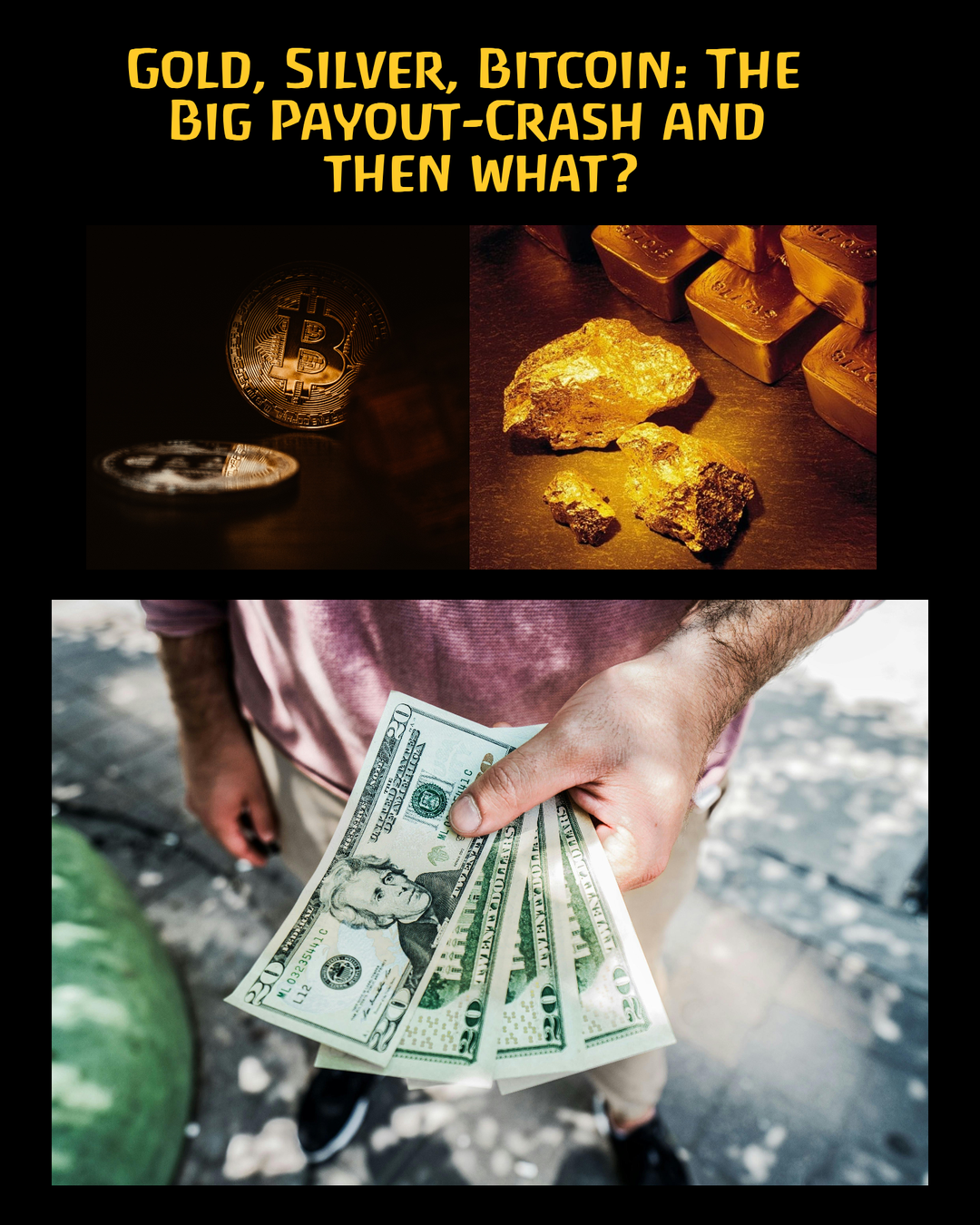
Any war, market crash, or period of stress eventually ends. Jobs, inflation, interest rates, unemployment, civil unrest, and the whole economic system; when everything is stacked against you, at some point you realize that to deal with anxiety, you have to start looking scary things in the eye. So that’s the first thing. In these apocalyptic times, there is no Julie Andrews’ Switzerland, no USA, no safe haven, no underground bunker that is going to practically help you. Instead, you have to learn to watch, one by one, as the Von Trapp family singers get fewer. You have to chart a course by turning off the collective music. You can only do that by learning new ways of thinking and engaging enough to start learning not just economics, but a new social life by dynamizing your life perspective.
We are all economically active. Active throughout our lives. In a way we have to take back thinking authority from universities, media, think tanks and global institutions: firstly in the soul: I like to think these newsletters could become like intel for the little guys, a collective group of Davids against Goliath, where what we share here can grow into a force that changes perspectives.
1 Samuel (33-37) David’s training as a shepherd prepared him.
And Saul said to David, “You are not able to go against this Philistine to fight with him; for you are a youth, and he is a man of war from his youth.” But David said to Saul, “Your servant used to keep his father’s sheep, and when a lion or a bear came and took a lamb out of the flock, I went out after it and struck it, and delivered the lamb from its mouth; and when it arose against me, I caught it by its beard, and struck and killed it.”
What is “generosity,” and in relation to money in its deepest principle?
It is giving away as the sharing of your soul and spirit. The new life we enable by providing something for another that otherwise wouldn’t have been there. Broadly, we have called this “endowment.” In German, “Stiftung.” I will define it again here for us: “enabling new life for others through giving away money.”
The Fed has been hiding “money printing” behind Quantitative Easing for years now, back to 2008. Back then, we were aghast at QE 1, 2, 3. They are controlling the narrative more adroitly now: regardless of whether the Fed calls it “organic balance-sheet growth” or “RMPs”, or intervention to maintain stability, any systematic buying that expands the central bank’s balance sheet operates as a pseudo form of QE by pumping fresh liquidity back into the financial system.
Think of the roaring 20s parallel. It’s not an explicit re-run of 100 years ago. It’s more like a global expansion of those conditions, Germany to Europe, Israel and the USA as Britain and America; but now Asia, Africa, South America thrown into the mix that can only utterly skew parallels to the 20s Great Depression and the world wars.
So, we have to keep going and keep swimming with the facts as they arise.
During a recent cabinet meeting at Camp David, a press photograph caught a glimpse over the shoulder of U.S. Treasury Secretary Scott Bessent. Underlined on his notepad was a literal “To Do” list that read: “Buy Japanese Yen (JPY) $5-10 bil.” This then sends the markets into a frenzy. Now, just like in 2008, you can find dozens of macroeconomic specialists on YouTube explaining how and why the stock market is going to crash and how gold and silver will multiply their values by 10 or more.
⚠️ 1. The Trap of Never Ending Accumulation
In 2026: Gold has soared to historic highs around $4,587 per ounce (a massive 37%+ jump over the past year). Similarly, Silver has crossed the threshold to $69.61 per ounce, up over 82% from its previous cycle.
Vague confusion sets in like a fog.
Then the questions shift to real physical Gold and Silver, or to paper-based ETFs and Mining Stocks. Or Bitcoin, AI, and Robotics. But if this was you then over the 16-year period leading up to May 2026, your gold rose by approximately 278% while silver rose by approximately 318% in nominal U.S. dollar terms, and if you were smart enough to have cashed in this year – what for?
A former acquaintance of mine, over the time I knew him, has been collecting silver and gold bars; leveraging them with plans for his future reich. He wasn’t 10% into gold as is sensible in an investment portfolio. He was 100% in. At the same time, he ran seminars where he would simply play YouTube videos and called it analysis.
Will he catch the market right and cash his winnings in?
Will he miss-time the next crash and correction and regret it for 20 years, anxiously watching the price. And what then: property, stocks, move to Argentina?
But none of this is the point. My argument here is for something very different. That the real driver of value in all this psychology is that you often treat your money, your life, and yourself as if you were dead. This is what makes a Goliath in the first place.
📈 2. Realities of the Current Market (And the Hoarding Illusion)
However many specialists advise the contrary, most people buy with the crowd at the top of the market and sell at the bottom, even when they know emotion should not overwhelm thinking. Swapping paper currency for gold bars or Bitcoin feels like escaping the matrix, but history shows that governments can change the rules. Gold confiscation. Or resetting it with a new basket of currencies as suggested before 2008 – at the last crisis – with SDRs (Special Drawing Rights).
“The world is going through the worst economic crisis in peacetime since the Great Depression. In around 150 countries, income per capita this year will be lower than in 2019. Many countries are less able to pay for vaccines or invest in their recovery – and are more indebted.
This is where a new SDR allocation comes in. It supplements countries’ reserves, using the collective strength of the Fund’s membership to make all 191 member countries a little stronger. It would provide liquidity support to many developing and low-income countries that are struggling, allowing them to pay for healthcare and support vulnerable people. All countries will benefit from a quick eradication of the virus. It is important to make sure they all have the financial resources to do that. IMF 7 Things You Need to Know About SDR Allocations. “
If we read carefully, this shows us something we all know intuitively well. Financial crises further agendas. Climate, Agenda 2020, 40. Carbon taxes. Vaccines and the Third World as pillars to keep such plans on track.
So, again, let’s learn to be cute: From modern emergency banking laws, to a total currency reset, if political turmoil hits or the digital grid fractures, your hidden gold or private crypto keys won’t easily buy you safety, health, or a plane ticket.
But there’s always the same question that triggers. What comes after the market crash and potential currency reset?
I once had a client who was Swiss pension fund executive preparing for his annual speech. He outlined something everyone in the pension industry kind of knew: pension funds were unsustainable. It’s like they’d all agreed to rearrange the chairs on the Titanic.
We are in fact surrounded by installed spokespeople demanding you save every penny for a far-off future. Advanced AI systems like Jump, FP Alpha, and Holistiplan are now standard tools firms use to scan tax records, and predict behavioral patterns (the feed tracks your every thinking whim).
These two quandaries about motivation and future orientation set up nicely; our first step through the veil: the need to undertake soul accounting.
Where have you become miserly not of money but of your very own soul? List the instances. Do an inventory. What joys do you shut down? What careful strategic position do you maintain to avoid meeting and learning new things? Look at yourself from outside with an uncompromising eye. What have you neglected to actually do, and more importantly, who have you neglected to be? When did you stop reaching out and being part of your own life as much as others’ lives, and where you have condemned others, what do you see of yourself mirrored in them? Where do you need to wake up to this emotional waste?
Now in your inventory of your soul, you’ll learn to see the two David and Goliath yous. The Good you – not before or after the crash or survival or battle you are protecting yourself from – but you free. And every time you buy the clothes, book the holidays, make the new connections you put off or disregard, you will learn to see the you and the others caring for their Goliaths.
These strikes at consciousness we have to do to ourselves: and they are about getting you out of your passive soul cage. We could even say there is a resentful version of you these global agendas would have you be.
⏱️ 3. Having a Spending rather than A Savings Plan
My acquaintance at £50,000 per ounce gold would say, “Hey, but I’m already rich, and will quite soon be getting even richer!” And sometimes I imagine a fantasy conversation with him at 92, where I ask him: “How much do you still need?” … Saving for the next incarnation? Where your feeling of safety is turned inside out, and you have to experience its opposite.
… But I guess at 92, he would still blankly say … time left for what?
As always, these letters are like a call, they start as a small seed, but we are learning to see the grain at the end of the deeds we do and don’t do.
Hebrews 7:7 And beyond all contradiction, the lesser is blessed by the greater.
Leave a Reply