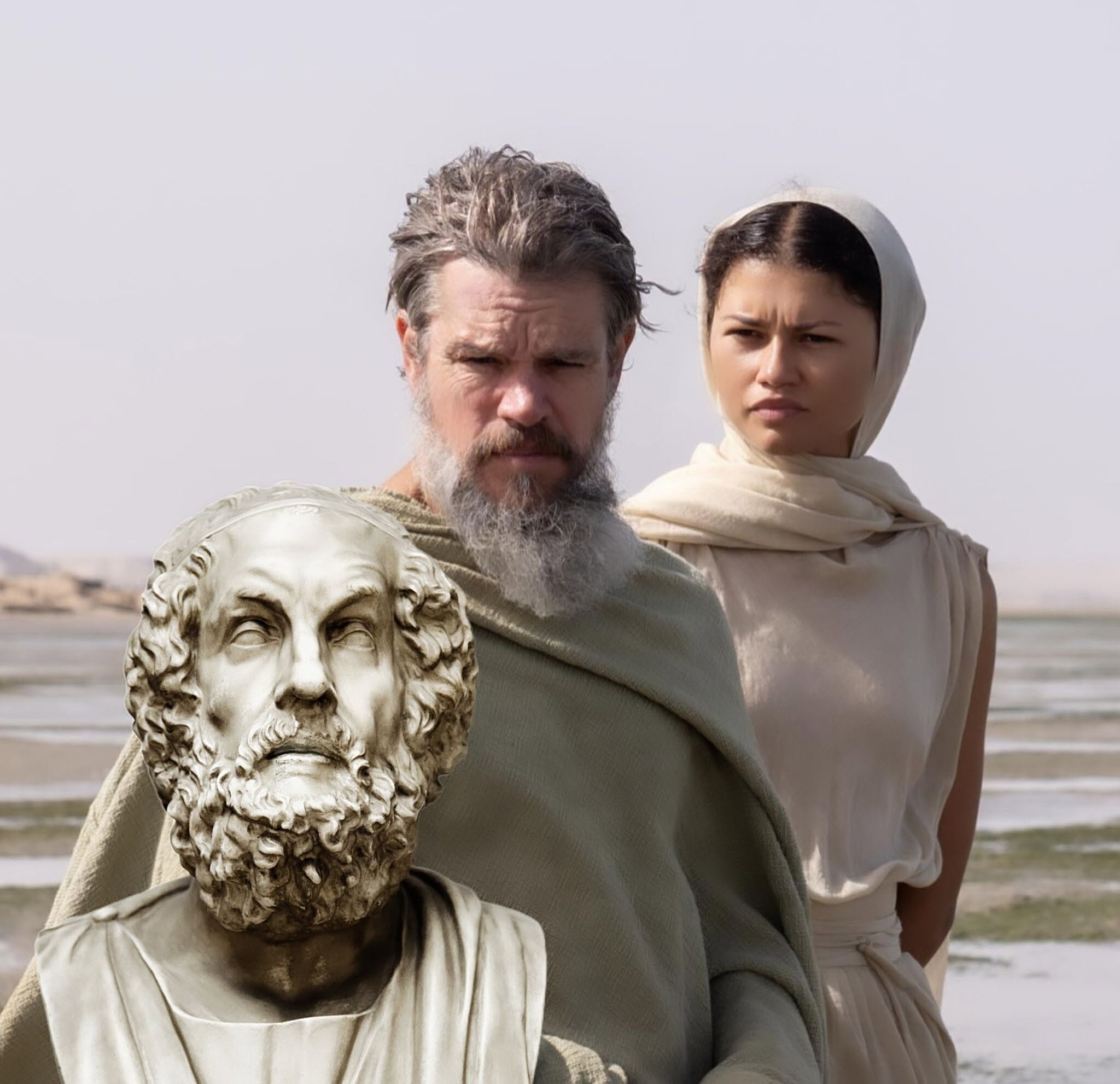
Don’t get me wrong, The Odyssey is a nice-to-watch modern movie, but it’s not Homer’s Odyssey. It is its drunk and retarded stepbrother. But it is, at least, more exciting than the American forever movie themes, where every hero is an FBI or CIA agent, using extreme force, destruction and torture as an excuse to protect the great USA or an “innocent” US citizen. You must be, as I am, fed up with multimillion-dollar movie themes such as saving the black or female US president from Armageddon, meteorites, and the Russians. The Odyssey is, at least, a change of scenery. Oppenheimer, the last multimillion-dollar movie directed by Nolan, was “goodish,” but things were different. Creating an image of a well-documented historical moment that happened just around the corner of time doesn’t compare with trying to portray a myth. Not to mention that what he portrayed in Oppenheimer is imprinted in the collective memory as a worldwide tragedy, making it less likely to fade than any other. When a tragedy takes place, the shock and the fear imprint the memory into the body like a hot iron and become a trigger for future trauma. Maybe not all of us know what we did yesterday, but we all know for sure what we did on 9/11, even if we were far from America. Oppenheimer was easy, based on my assessment, because there are still people alive to remember Hiroshima and Nagasaki.
Nolan has always tried to instil his alternative reality in historical movies, even in Oppenheimer. The supposed scene with Einstein and Oppenheimer was hard to watch for a person who likes a historical movie to be accurate. This time, with The Odyssey, Nolan ventured into things that were not clear as day in collective memory. But, on the good side of his creativity, he had the chance to explore more of his alterations and alternative realities. On the bad side, superficial people can take them as true, not understanding that a bored millionaire just plays around. Humanity as a whole forgot completely how it was millennia back, and here was a good chance for Nolan to shine. But unfortunately, his overall interpretation of Homer’s work dwells between cruel materialism and childish silliness. The movie is beautiful, but the Gods are gone, facts are stretched and deliberately mixed up under Hollywood’s latest customs: to rewrite an alternative history for compliant idiots.
Because his work always revealed his greatness, people have asked themselves for centuries if Homer really existed. To this, Rudolf Steiner responded with “yes”, although many initiates, including Goethe, fell into the trap of believing he was not real. Not only was he a real person, but he was, in fact, Odysseus himself in an immediately previous incarnation. Steiner gives this indication to the participants of the cultic section, and the notes are included in the volume “Mystica Aerterna”. So the Iliad and the Odyssey can be interpreted by the spiritual science in a threefold manner: one, as a spiritually objective historical fact; two, as an objective process of Initiation; and three, as a personal karmic recall. So, the first opportunity Nolan missed here was to present Odysseus in relation to its narrator, Homer.
Maybe one of the most common criticisms of the movie is that in Nolan’s Odyssey, the Greek gods are almost forgotten. For reasons unknown to us, Nolan decided to keep them all out. He kept only Athena, maybe because in Homer’s Odyssey, she was actually the main character and not a supportive one. Nothing takes place in the Odyssey without Athena. It’s difficult to escape her. From the beginning, we see how Pallas Athena incorporates different people to address Telemachus. For instance, she most frequently incorporates Mentor. Today, the word “mentor” means “teacher,” but this was only after the Odyssey was adopted into culture by the Romans. Mentor was Telemachus’ teacher only when Athena incorporated him. There is an incredible instance in the Odyssey when Athena leaves Mentor, and Mentor addresses Telemachus alone, saying (I am paraphrasing), “Boy, the Gods must really love you”. Mentor was aware that he was visited at times and not always talking from himself. He then asks Athena to bless him and his family, maybe in the account that she used his body as a tool frequently.
We can ask, was Nolan right to dismiss the Gods in the Odyssey? How important were they really? We can understand this only with Rudolf Steiner’s help. In those times, life on Earth didn’t happen as it does today. The third hierarchy (Archai, Archangels and Angels) was very active in human life up to the physical. Nolan portrays Athena in the background of Odysseus’ soul, but this is not historically accurate. Today we are freer in relation to the third hierarchy than in Homer’s time. In the lectures from 15 and 16 April 1909, contained in the volume “Spiritual Hierarchies and their Reflection in the Physical World” (GA110), Rudolf Steiner talks about how the third hierarchy acted directly in the physical plane in different stages of humanity. In Lemurian times, Archai would frequently descend in a human physical body to influence Earth affairs and guide humanity, especially related to migration. In Atlantean times, Archangels would frequently descend in human physical and etheric bodies to teach different groups of people. The Atlantean Priests were all incorporated by different Archangels. This is how the Oracles were formed, in relation to the Archangels corresponding to the planets. When a human being incorporated by an Archangel died, his physical body dissolved, but his etheric body was preserved. Later, the 7 etheric bodies of the Oracles’ Priests previously incorporated by the 7 Archangels were given to the 7 Rishis. In our post-Atlantean epoch, Rudolf Steiner tells us that Archai and Archangels mostly withdrew from directly influencing the course of history, but not completely. They still intervene in such a way from time to time, including in our present time. For instance, Master Buddha was incorporated by an Archai. This is why Helena Blavatsky called him Mercury-Buddha. However, their action in the physical is less frequent than in older times.
In the post-Atlantean epoch, the epoch that starts after the biblical flood, Angels have taken up this activity. Rudolf Steiner tells us that all Gods in Greek and German mythologies are angels. To influence physical events, especially at the beginning of the post-Atlantean epoch, angels descended into the physical, etheric, and astral bodies of men. Athena, Hermes, and Zeus are not personal angels of different personalities, but angels whose mission was to direct different groups of people through their leaders. In the Odyssey, Athena also mentions Odysseus’ spirit once, which clarifies that she is not his own guiding spirit. Sometimes, as the Greek and German legends tell us, these historically ruling angels even got in conflict with one another. So when Athena incorporates different people at times to guide Odysseus and his activities, this is not without meaning. And here again, Nolan missed the opportunity to present this process with the help of special effects. He could have portrayed, for instance, Mentor changing his appearance with Athena. This would have given his favourite female actor, Zendaya, a much more meaningful role in the movie.
As anthroposophists, we know that in older times humanity still had natural clairvoyance. There was no question for any human being, wealthy or poor, smart or idiot, good or evil, whether the Gods or, in general, the Spiritual exist. They were perceivable with a natural clairvoyant sight that everyone had. In the same way, today we see clearly the physical plane (which was not so in all times; humanity had to conquer the physical plane gradually), humans of the past could perceive the angels and other spiritual beings astrally. In contrast to today, the physical sight was less developed back then. Old clairvoyance slowly became extinct as humanity gained consciousness. Homer’s Odyssey speaks of a transition period when humanity could still rely on the relics of the old clairvoyance. Humans were still guided directly by the Gods, but they started to have individual thoughts as well. This way, it was possible, for instance, to disobey a God. Back then, humans were like toddlers who learnt to say “no”. This is why Antinous, the most arrogant suitor of Penelope, sees that Athena is guiding Telemachus through Mentor, and despite the fact that he recognises Athena in Mentor, he still wants to kill Telemachus.
Another thing I would have wanted for the movie was Nolan to understand that Odysseus went through a spiritual Initiation and all milestones presented by Homer are equally important. For instance, Circe is the witch who makes parts of the soul appear in their true animalic form. Does it remind us of anything? Yes, it is a portrayal of the Lower Guardian. But the angel Hermes (Hermes represents the light of occult Mercury, Venus in our modern denomination, the true clairvoyant vision) helps Odysseus to preserve his human form when meeting Circe. Odysseus becomes Circe’s lover for one year, which in initiatic language means he is becoming the Lower Guardian’s disciple. Circe is the master of imaginative forms; she can transform anything into anything. This is the quality of the elementary world. Experiences in the elementary world, the meeting with the Lower Guardian, passing the Threshold of death, receiving the forgetfulness drink, birthing the new memory, the solar experience, the Midnight Hour of the worlds and returning to incarnation are all stages presented in Homer’s Odyssey.
Not only did Nolan skip initiatic phases in the movie, but he also mixed them up, chaotically misusing the Homeric symbolism. For instance, the lotus eating, which is the equivalent of receiving the forgetfulness drink, was presented in the movie in relation to Calypso. The Calypso phase, however, is a much later stage, when the dead between incarnations or, in this case, the Initiate, is at the Midnight Hour of the world and longs to come again in incarnation.
There are many things to be said about Homer’s Odyssey and very little about Nolan’s movie. It is a tragedy that such a destruction of art and spirit, like this movie proved to be, is, in fact, rewarded with millions of dollars over the shoulders of millions of children dying elsewhere in the world. Some of you will tell me: You are exaggerating, there is no connection between the two! And I must tell you: Ahriman cannot really turn the bread into stones. He has to drain life somewhere in the world to make his magic appear somewhere else. I’ve seen the movie; I paid for it. My money, whether I like it or not, supports Hollywood’s actors’ lavish existence, while destroying everything true and beautiful about this world in memory and representation. I helped Zendaya dress better for the Met Gala, where elites are lately recruited for political occultism. But on the good side, I came to look more carefully into Homer’s Odyssey and write this piece of thought for you all. May we always seek truth, beauty and good!
I recognise you
I AM
Leave a Reply